
When we wash our cars, we usually focus on the parts we can see. We spend hours polishing the paint until it shines like a mirror. We scrub the wheels until they sparkle. We vacuum the interior until every crumb is gone. But there are two huge areas of the vehicle that most people completely ignore simply because they are hidden. I am talking about the engine bay and the underbody. These are the “guts” of your car. The engine is the heart that pumps power to the wheels, and the underbody is the skeleton that holds everything together. Just because you cannot see them does not mean they are not getting dirty. In fact, they are usually the dirtiest parts of the entire vehicle.
If you have ever opened your hood and seen a thick layer of black grease covering everything, or if you live in a snowy area and worry about the salt eating your frame, this guide is for you. Cleaning the engine and the underbody might seem scary. You might worry about spraying water on sensitive electronics or washing away important grease. These are valid concerns, but with the right technique, it is completely safe. It is also one of the most satisfying jobs you can do. Seeing a greasy, dusty engine turn brand new again is a great feeling. In this blog, we are going to walk through exactly how to deep clean these hidden areas using simple tools and simple English, so you can keep your car running cool and rust-free for years to come.
Why Cleaning the Engine and Underbody Is Not Just About Looks
You might be asking yourself why you should bother cleaning something that nobody sees. Who cares if the engine is dirty if the hood is closed? The answer is heat and rust. An engine is a giant heat generator. It is designed to get hot, but it also needs to shed that heat effectively to run well. When a thick layer of oil, dirt, and dust builds up on the engine block, it acts like a winter coat. It traps the heat inside. This forces the engine to work harder to stay cool, which can shorten the life of the gaskets and seals. A clean engine runs cooler. It is also much easier to spot leaks. If your engine is covered in old grime, you will never see a fresh oil leak until it is too late. If the engine is spotless, a new leak stands out like a sore thumb, allowing you to fix it cheaply before it becomes a disaster.
The underbody is even more critical. This is where your car fights its war against the road. Every time you drive, your tires kick up rocks, mud, water, and—worst of all—road salt. Salt is chemically aggressive. It eats steel. If you let wet, salty mud sit on your frame rails or suspension arms, it will rust them from the inside out. We have all seen old cars with holes rusted through the bottom. That happens because of neglect. By cleaning the underbody regularly, especially in winter, you are literally washing away the cancer that kills cars. It protects your investment and keeps the structural integrity of the vehicle safe.
Preparing the Engine Bay and Protecting Sensitive Parts
Before you grab the hose, you need to do a little prep work. The most important rule of engine cleaning is temperature. Never, ever wash a hot engine. If you spray cold water on a red-hot exhaust manifold or engine block, the metal can crack instantly due to the thermal shock. This is a mistake that costs thousands of dollars to fix. Open the hood and let the car sit for at least an hour. You want it to be warm to the touch, but not hot. A slightly warm engine helps loosen the grease, but a hot one is dangerous.
Once the engine is cool, look for the sensitive bits. Modern cars are pretty waterproof, but you should still be careful around the alternator, the battery, and the air intake. The alternator is the round metal part with vents in it. If you flood it with water, it can short out. The air intake is the big plastic tube that sucks air into the engine. If water gets in there, it goes straight into the cylinders and can destroy the engine (this is called hydrolock).
Grab some plastic grocery bags or Ziploc bags and some rubber bands or tape. Cover the alternator, the fuse box, and the exposed air filter (if you have an aftermarket one). Wrap the bags around them and secure them. This acts like a raincoat. You don’t need to make it watertight like a submarine, just splash-proof. Also, remove any loose leaves or pine needles by hand or with a vacuum cleaner. If these get wet, they turn into mush and clog your drain holes, which can cause rust later.
The Magic of Degreaser Breaking Down the Grime
Now that the engine is prepped, it is time for the chemical warfare. Water alone will not touch engine grease. Oil and water do not mix. You need a degreaser. This is a strong soap designed to cut through heavy oil and road tar. You can buy “Engine Degreaser” at any auto parts store, or use a strong All-Purpose Cleaner (APC) diluted with water.
Spray the degreaser liberally all over the engine bay. Cover everything. Spray the valve cover, the hoses, the plastic covers, and the firewall (the back wall of the engine bay). Pay special attention to the areas lower down where oil tends to seep and collect dirt. Avoid spraying it directly onto the drive belts (the rubber belts on the front of the engine) if you can, as harsh chemicals can dry out the rubber and make them squeak.
Let the degreaser sit for about three to five minutes. This is called “dwell time.” You want the chemical to do the hard work for you. Watch as the grime starts to run off. However, do not let it dry. If degreaser dries on plastic or aluminum, it can leave white stains that are very hard to remove. If it is a hot day, mist it with a little water to keep it wet while it works.
Agitating the Dirt Brushes are Your Best Friend
Chemicals are great, but for a truly professional result, you need friction. While the degreaser is soaking, grab a brush. You don’t need expensive detailing brushes; an old paintbrush or a stiff-bristled wheel brush works perfectly.
Start scrubbing. Focus on the nooks and crannies. Scrub the plastic engine cover. Scrub the rubber hoses. Scrub the metal alternator bracket (avoiding the alternator itself). This agitation lifts the dirt that has been baked onto the surface for years. You will see the foam turn brown or black. This is satisfying because it means the dirt is leaving your car.
If you have a really dirty area, like an oil leak near the bottom, you might need a stiff wire brush or a scraper, but be very careful not to scratch the metal or cut a rubber hose. For the large flat surfaces, you can use a wash mitt designated for the engine (don’t use the one you use on your paint!). Wiping down the underside of the hood is also a good idea. It often gets forgotten, but it collects a lot of oil vapors and dust.
Rinsing Safely The Low Pressure Technique
Now it is time to rinse. This is the part that makes people nervous. They imagine blasting the engine with a fire hose. Do not do that. You do not need high pressure. In fact, high pressure is bad because it forces water into electrical connectors where it doesn’t belong.
Use a standard garden hose with a nozzle set to “Shower” or “Mist.” You want a gentle flow of water. Rinse from the back to the front, washing all the soap and loosened dirt down and out of the engine bay. Be deliberate. Don’t just spray wildly. Aim the water at the soapy parts and rinse them clean.
Try to avoid holding the spray directly on electrical plugs, the fuse box, or the spark plug wells for too long. A quick pass is fine, but don’t drown them. If you see pools of water sitting in cup-shaped areas on top of the engine, try to blow them out or soak them up with a towel. Once the water runs clear and there are no more suds, you are done with the water. Remove the plastic bags you put on the alternator and air intake.
Drying and Dressing The Secret to a Showroom Look
A wet engine looks clean, but a dry engine can look spotty if you aren’t careful. Hard water spots can form on the black plastic, making it look chalky. You need to dry the engine bay just like you dry the rest of the car.
The best tool for this is air. If you have a leaf blower, a shop vac on “blow” mode, or an air compressor, use it. Blast the air into all the cracks and crevices to force the standing water out. This is crucial for bolt heads and electrical connectors. If you don’t have air tools, use an old microfiber towel (one you don’t mind getting greasy) and wipe everything down by hand. Start the engine and let it run for five minutes. The heat from the engine will help evaporate the remaining moisture quickly.
Once it is dry, the black plastic might look a little faded. This is where “Engine Dressing” comes in. This is a spray that makes plastic and rubber look wet and shiny (or satin, depending on the product). Spray it liberally over the entire engine bay—hoses, plastic covers, and even the metal parts. Close the hood and run the engine for another ten minutes. The heat helps the dressing settle and level out. When you open the hood again, it will look better than new. The hoses will be deep black, and the plastic will shine. It is an incredible transformation.
The Underbody The Battlefield Against Rust
Now, let us move underneath. The underbody is the most hostile environment on a vehicle. It is constantly bombarded by rocks, water, and salt. Unlike the engine, you don’t really need to worry about “pretty.” You need to worry about “clean.”
The biggest enemy here is mud. Mud holds moisture. If you go off-roading or drive down a dirt road, mud gets packed into the corners of the frame rails and wheel wells. It sits there like a wet sponge, pressing water against the metal for days or weeks. This causes rust. In winter, road salt mixes with this mud to create a corrosive paste that eats through brake lines and suspension parts.
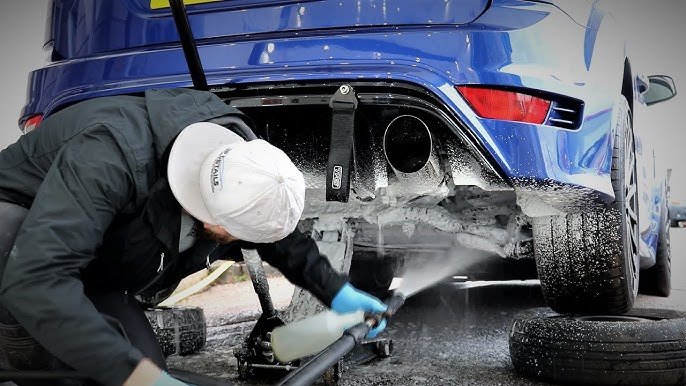
Cleaning the underbody is awkward because you can’t easily see it. You have to get on your knees. If you have a pressure washer, this is the one time you can use high pressure. You want to blast that mud out. If you don’t have a pressure washer, a garden hose with a strong “Jet” nozzle is your best option.
Specialized Tools for Reaching the Undercarriage
Because it is hard to reach under a car, companies have invented some clever tools to help. The best one is an “Undercarriage Cleaner” or “Water Broom.” This is a long attachment with wheels that connects to your pressure washer. It has three or four spray nozzles pointing straight up.
You simply roll it under the car like a vacuum cleaner. The jets blast water straight up into the bottom of the vehicle. It is incredibly effective at rinsing away salt and mud without you having to crawl on the wet ground. You just walk back and forth along the sides of the car, pushing the broom underneath.
If you don’t want to buy a special tool, you can use a lawn sprinkler. Yes, a simple oscillating sprinkler that you use to water the grass. Hook it up to the hose, slide it under the middle of the car, and turn it on full blast. Let it run for ten minutes. The water shoots up and hits the bottom of the car, slowly loosening and rinsing away the grime. Move it forward or backward every few minutes to cover the whole length of the vehicle. It is a cheap, lazy, and effective hack.
Rust Prevention and Protection After Cleaning
Once the underbody is clean and dry, you have a golden opportunity to protect it. Since you have removed the mud and salt, the metal is exposed. If you live in the Rust Belt (areas with heavy snow and salt), you should consider applying a “Fluid Film” or an oil-based undercoating.
These are sprays that coat the metal in a thick, waxy, oily layer. Unlike rubberized undercoatings (which can trap moisture and cause rot), oil-based coatings repel water. They creep into the seams and welds where rust starts. You can buy aerosol cans of this stuff and spray the frame rails, the suspension arms, and the bottom of the doors.
It is messy, but it works. Do not spray it on the exhaust (it will burn and smell terrible) or the brakes (you won’t be able to stop). Focus on the structural steel parts. Doing this once a year, usually in the fall before the snow starts, can extend the life of your car by ten years. It stops the rust before it starts.
Conclusion The Reward of a Thorough Clean
Cleaning the engine and the underbody is not the most glamorous part of car care. You don’t get the instant gratification of seeing a shiny hood or sparkling wheels. You get wet, you get greasy, and you spend a lot of time bending over. But it is the most important cleaning you can do for the longevity of your vehicle.
When you open the hood to check your oil and see a pristine engine, it feels good. It makes maintenance easier. It makes the car run cooler. And knowing that your underbody is free of salt and mud gives you peace of mind that your car is safe and solid.
So, the next time you wash your car, take an extra thirty minutes. Pop the hood. Grab the degreaser. Crawl underneath with the hose. Your car takes care of you every day, driving you to work and keeping you safe. This is your chance to take care of it, protecting the vital parts that keep it moving. It is a dirty job, but the results are absolutely worth it.