When we think about our cars, we usually obsess over the things that make them go. We talk about horsepower, acceleration, and fuel economy. We love the feeling of pressing the gas pedal and feeling the engine surge to life. But there is a system in your car that is infinitely more important than the engine. It is the system that makes you stop. The brake system is the single most critical safety feature on any vehicle. You can drive a car with a broken air conditioner, a dented bumper, or even a sputtering engine, but you cannot drive a car with broken brakes.
Despite this, brakes are often ignored until they start making noise. We turn up the radio to drown out the squealing sound. We ignore the slight vibration in the steering wheel when we stop. We tell ourselves we will fix it “next month.” But neglecting your brakes is a dangerous game. A healthy brake system is the difference between a close call and a serious accident. It is the difference between stopping at a red light and sliding into the intersection. The good news is that brake maintenance is not a mystery. It is a logical, mechanical system that gives you plenty of warning signs before it fails. By understanding how it works and what to look for, you can keep your car safe, save money on expensive repairs, and drive with total confidence. This guide is going to walk you through everything you need to know about your brakes, using simple, plain English to explain the parts, the problems, and the solutions.
How Your Brakes Actually Work: The Magic of Friction
To take care of your brakes, you first need to understand what is happening when you press that pedal. It feels like magic—you tap your foot, and a 4,000-pound metal beast comes to a halt—but it is actually physics. Specifically, it is the physics of friction and hydraulics.
When you press the brake pedal, you are not pushing the brakes directly. You are pushing a lever that pushes a piston into a cylinder filled with fluid. This fluid (brake fluid) cannot be compressed. It acts like a solid rod. The force from your foot travels through the fluid, down thin metal tubes (brake lines), to the four corners of your car. At each wheel, this pressure pushes a set of “pads” against a spinning metal disc called a “rotor.”
Think of it like stopping a spinning bicycle wheel with your hands. You squeeze the tire with your hands, and the friction creates heat and slows the wheel down. Your car does the exact same thing, but with much more force. The brake pads are the “hands,” and the rotor is the “wheel.” Over time, this friction wears down the pads (just like it would wear down the skin on your hands). The rotor also gets thinner. The heat generated is intense—hundreds of degrees—which can eventually cook the fluid. This is why the entire system needs regular love. It is a system designed to destroy itself slowly in order to save you.
The Warning Signs: Listen to What Your Car Is Telling You
Your car talks to you. It might not use words, but it uses sounds and feelings to warn you when something is wrong. The most common language of the brake system is noise. If you hear a high-pitched squeal when you press the brake pedal, that is your car screaming for help.
This sound usually comes from a tiny piece of metal called a “wear indicator.” Manufacturers put this little metal tab on the brake pad specifically to make an annoying noise when the pad gets too thin. It is like a built-in alarm clock. If you hear it, you haven’t destroyed anything yet, but you are close. You have maybe a few weeks of driving left before the pads are gone completely.
If you ignore the squeal, the sound will change. It will turn into a deep, harsh grinding noise. This sounds like metal crunching against metal. That is exactly what it is. The brake pad material is completely gone, and the metal backing plate is now digging into the metal rotor. This is catastrophic. It means you are destroying the expensive rotors, and your braking power is almost zero. You might also feel a vibration or “shudder” in the steering wheel when you brake. This usually means the rotors are “warped” (uneven due to heat) and need to be replaced. Listen to these signs. Catching a squeal costs a hundred dollars; fixing a grind costs five hundred.
Brake Pads: The First Line of Defense
The brake pads are the consumable part of the system. They are like the erasers on a pencil or the soles of your shoes. They are designed to wear out. A brake pad consists of a metal backing plate with a thick layer of friction material glued to it. This material is a mix of metals, ceramics, and graphites designed to bite into the spinning rotor without melting.
How long do they last? That depends entirely on how you drive. If you do mostly highway driving where you rarely touch the brakes, pads can last 50,000 miles or more. If you drive in stop-and-go city traffic, or if you ride the brake pedal down hills, they might only last 15,000 miles.
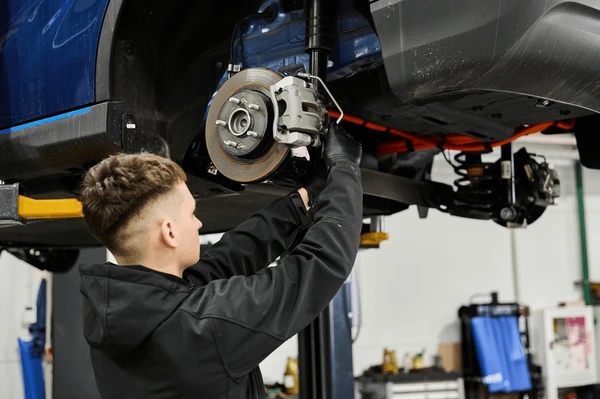
Checking them is easy. You can often see the brake pads through the holes in your wheels. Look at the rotor (the shiny disc). There is a caliper (a clamp) over it. Inside that clamp, you will see the pad touching the rotor. If the pad looks thick—like a candy bar—it is good. If it looks thin—like a piece of cardboard—it is time to change it. Most mechanics recommend replacing pads when the friction material is about 3 millimeters thick. Do not wait until it hits zero. As the pad gets thinner, it can’t absorb as much heat, which can boil your brake fluid and lead to “brake fade” where the pedal goes to the floor but the car doesn’t stop.
Rotors and Calipers: The Heavy Lifting Hardware
While the pads do the gripping, the rotors and calipers do the supporting. The rotor (or disc) is the big, shiny metal circle you see behind your wheels. It needs to be perfectly flat and smooth. If it has grooves in it (from worn-out pads) or if it is warped (from overheating), the pads won’t make good contact.
When you get your brakes changed, the mechanic will measure the thickness of the rotors. If they are thick enough, they can sometimes be “resurfaced” or “turned.” This means putting them on a machine that shaves off a tiny layer of metal to make them flat again. However, modern rotors are often made thinner to save weight, so they usually just need to be replaced. Always replace rotors in pairs (both fronts or both rears) to keep the braking even.
The caliper is the clamp that holds the pads. It has a piston inside that squeezes the pads when you press the pedal. Calipers are tough, but they have enemies: rust and dirt. Sometimes, a caliper piston can get stuck or “seized.” If this happens, the brake pad will drag against the rotor constantly, even when your foot is off the pedal. You might smell a burning smell, feel the car pulling to one side, or notice one wheel is much hotter than the others. A seized caliper is dangerous and needs to be replaced immediately.
Brake Fluid: The Forgotten Component
Brake fluid is the most neglected fluid in the entire car. People change their oil religiously, but they will drive for ten years on the same brake fluid. This is a huge mistake. Brake fluid is “hygroscopic,” which is a fancy scientific word meaning it absorbs water from the air. Even though the brake system is sealed, moisture finds its way in through microscopic pores in the rubber hoses and seals.
Water is the enemy of brakes. First, water boils at 212 degrees Fahrenheit. Brake fluid boils at 400 degrees or more. If your fluid is full of water and you brake hard (like going down a mountain), the heat can boil the water inside the lines. When water turns to steam, it becomes compressible. You press the pedal, it squishes the steam, and the brakes don’t work. The pedal goes straight to the floor. It is a terrifying experience called “brake fade.”
Second, water causes rust. It will rust the brake lines and the expensive ABS pump from the inside out. You can check your brake fluid by looking at the reservoir under the hood (it is usually a clear plastic tank near the driver’s side firewall). Fresh fluid looks like clear apple juice or light oil. Old, bad fluid looks like dark coffee or soy sauce. Most manufacturers recommend flushing the brake fluid every two years or 30,000 miles. It is a cheap service that protects the most expensive parts of the system.
The Mystery of the Brake Light on Your Dashboard
One day, you are driving along, and a red light pops up on your dashboard. It usually says “BRAKE” or shows a circle with an exclamation mark inside parentheses. This light is serious. It is not like a “Check Engine” light that you can ignore for a week. The red brake light means one of two things.
First, check your parking brake (or emergency brake). If the handle is pulled up even one click, the light will stay on. Release it fully. If the light stays on, you have a hydraulic problem.
Usually, this means your brake fluid is low. The reservoir has a sensor in it. If the fluid drops below the “Min” line, the light triggers. Do not just top it off and forget about it. Brake fluid does not evaporate like oil. If it is low, it means it is leaking somewhere. You might have a hole in a brake line or a leaking caliper. This is a safety emergency. You should not drive the car if the pedal feels spongy. Get it towed to a shop. Sometimes, low fluid just means your brake pads are very worn (as the pads get thinner, the caliper piston moves out further, and more fluid fills the space behind it), but you still need to have it checked to confirm.
Driving Habits That Extend Brake Life
You can double the life of your brakes simply by changing how you drive. The biggest killer of brakes is aggressive driving. If you are the type of driver who accelerates until the last possible second and then slams on the brakes at a red light, you are burning money.
Try “coasting.” When you see a red light or stop sign ahead, take your foot off the gas early. Let the air resistance and engine friction slow the car down naturally. By the time you actually need to press the brake pedal, you might only be going 20 mph instead of 40 mph. This cuts the heat generation in half.
Also, be careful on hills. If you are driving down a long, steep mountain road, do not ride the brake pedal the whole way down. This constant friction builds up incredible heat that can warp rotors and boil fluid. Instead, shift your car into a lower gear (L or 2 on an automatic, or downshift on a manual). This uses “engine braking” to hold the car back, saving your brakes for the sharp corners where you really need them. Also, unload your car. If you are carrying 200 pounds of old gym equipment and tools in your trunk for no reason, your brakes have to work harder to stop that extra weight every single time. Travel light to save your brakes (and your gas).
Upgrading Your Brakes When to Go Big
For most daily driving, the standard brakes that came with your car (OEM) are perfectly fine. They are quiet, dusty, and work well when cold. But sometimes, you might need an upgrade. If you tow a heavy trailer, if you drive in the mountains frequently, or if you do “spirited” driving on weekends, stock brakes might not be enough.
The most common upgrade is better pads. You can buy “ceramic” pads which create very little dust (keeping your wheels clean) and last a long time, but they don’t bite as hard when they are freezing cold. Or you can buy “performance” pads which bite incredibly hard and resist heat, but they create a lot of black dust and might squeal a little bit.
You can also upgrade rotors. You might have seen rotors with holes drilled in them or slots carved into them. These look cool, but they also have a function. The holes and slots help hot gas and dust escape from between the pad and the rotor, keeping the brakes cooler during extreme use. However, for a normal grocery-getter car, drilled rotors are usually overkill and can crack if not made well. Stick to high-quality blank rotors and premium pads for the best balance of safety and longevity.
DIY vs Professional When to Call a Mechanic
Brake jobs are the “gateway drug” of DIY mechanics. Changing pads and rotors is actually very straightforward. It is just bolts and clamps. There are thousands of YouTube videos showing exactly how to do it for almost every car model. If you are handy with tools, doing your own brakes can save you hundreds of dollars in labor costs. You can buy premium parts for a fraction of what a dealer charges for basic ones.
However, brakes are safety-critical. If you leave a bolt loose on an alternator, your car stops running. If you leave a bolt loose on a brake caliper, your car stops stopping. That is a huge risk. If you are not 100% confident in your ability to torque bolts correctly and bleed hydraulic lines without getting air bubbles in them, take it to a professional.
Also, some modern cars have electronic parking brakes. These require a special computer scanner to retract the rear calipers before you can change the pads. If you try to force them with a C-clamp like on an old car, you will break the expensive electronic motor. If your car is complicated, pay the pro. It is worth the peace of mind knowing that when you hit that pedal, the car will stop every single time.
Conclusion The Confidence of Safety
Maintaining your brake system is about more than just avoiding a repair bill. It is about confidence. There is a specific peace of mind that comes from driving a car that you know is safe. You know the pads are thick. You know the fluid is clean. You know the rotors are smooth.
When a deer jumps out in front of you on a dark road, or when traffic on the highway comes to a sudden screeching halt, you don’t have to panic. You just react. You press the pedal, and the system does exactly what it was designed to do. It converts all that speed into heat and