When you get behind the wheel of your car, you expect two things to happen without fail. First, you expect the car to go where you point it. Second, and perhaps most importantly, you expect it to stop when you press the pedal. We often take these functions for granted. We turn up the music, enjoy the air conditioning, and cruise down the highway, trusting that the thousands of pounds of metal beneath us will behave exactly as it should. But the systems responsible for your safety and comfort—the brakes and the suspension—are working incredibly hard every single second you drive. They are taking a beating from potholes, absorbing the heat of friction, and battling the forces of gravity and physics to keep you safe.
Despite their importance, brakes and suspension are often the most neglected parts of a vehicle until something goes wrong. We ignore the slight squeak at a stop sign. We get used to the car bouncing a little extra over speed bumps. We unknowingly adjust our steering to compensate for a pull to the left. But these are not just quirks of an aging car; they are warning signs. Ignoring them can lead to expensive repairs later, or worse, a dangerous situation on the road. Understanding how these systems work and how to maintain them does not require an engineering degree. It just requires a little attention and knowledge. In this guide, we are going to explore the critical world of stopping and handling. We will break down the components, explain the symptoms of failure in simple English, and help you decide when to fix it yourself and when to call a professional.
Understanding How Your Car Actually Stops The Basics
To maintain your brakes, you first need to understand the magic that happens when you press that pedal. It feels instantaneous, but it is actually a chain reaction of physics. When you press the brake pedal, you are not physically pushing the brakes at the wheels. You are pushing a lever that pushes a piston into a cylinder filled with fluid. This fluid, called brake fluid, cannot be compressed. It acts like a solid rod. The force from your foot travels through the fluid, down thin metal tubes called brake lines, to all four corners of the car.
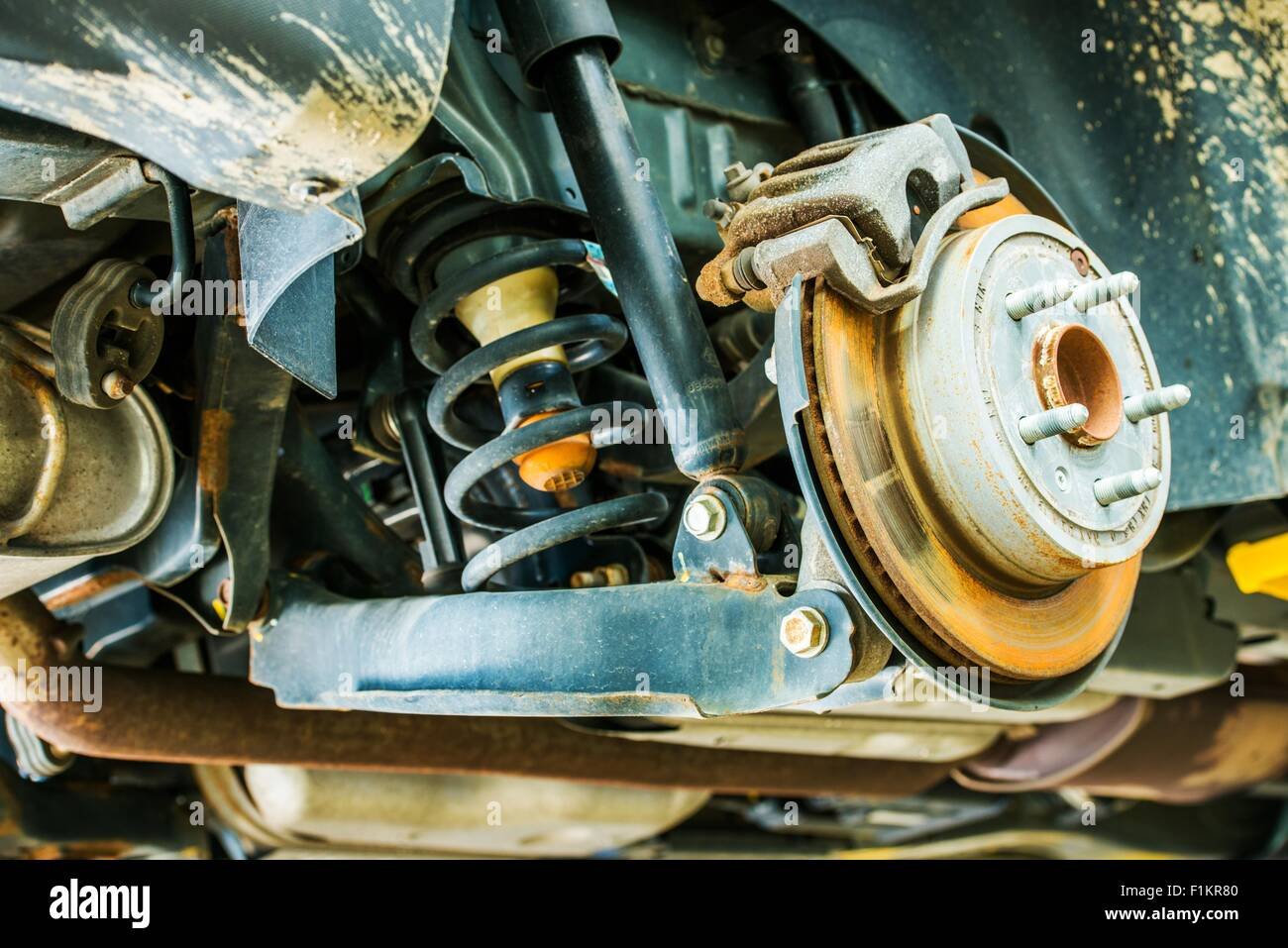
At each wheel, this hydraulic pressure pushes a mechanism called a caliper. Think of the caliper like a giant hand. Inside the hand are “pads” made of friction material. The caliper squeezes these pads against a spinning metal disc called the “rotor.” This is exactly like squeezing the handbrake on a bicycle, where the rubber pads squeeze the rim of the tire. The friction between the pads and the rotor creates immense heat, and this heat is what slows the car down. It converts the energy of motion into heat energy. This process happens thousands of times over the life of your car. Naturally, rubbing two things together causes them to wear out. The pads get thinner, the rotors get grooved, and the fluid gets hot. Understanding that your brakes are a “consumable” item, just like gasoline or tires, is the first step in proper maintenance.
The Warning Signs Why Your Brakes Are Screaming at You
Your car talks to you. It might not use words, but it uses sounds and sensations to tell you when it is hurting. The most common language of the brake system is noise. If you hear a high-pitched squeal or chirp when you lightly press the brake pedal, do not panic immediately. This is often a built-in safety feature. Brake manufacturers attach a tiny piece of metal called a “wear indicator” to the brake pads. When the pad material gets too thin, this little metal tab touches the rotor and makes that annoying sound. It is your car’s way of saying, “Hey, I need new shoes soon.”
However, if you ignore that squeal, the sound will change. It will turn into a deep, harsh grinding noise that sounds like metal crunching against metal. That is exactly what it is. The brake pad material is completely gone, and the metal backing plate is now digging into the expensive metal rotor. This is a “stop driving immediately” situation. Aside from noise, pay attention to how the pedal feels. If the pedal feels “spongy” or soft, like stepping on a ripe plum, it usually means there is air bubbles in the brake lines. Air compresses (unlike fluid), so your foot is just squishing air instead of pushing the brakes. If the car pulls hard to one side when you brake, it usually means a caliper on one side is stuck, forcing the other side to do all the work. Listening to these signs early can save you hundreds of dollars.
Brake Pads and Rotors The Dynamic Duo of Stopping Power
The two most common repairs you will face are replacing pads and rotors. These are the parts that physically touch and wear down. Brake pads come in different materials. “Organic” pads are soft and quiet but wear out fast and make a lot of black dust. “Semi-metallic” pads are harder and handle heat better, but they can be noisy. “Ceramic” pads are the modern standard for most passenger cars; they are quiet, produce very little dust, and last a long time.
Rotors are the big metal discs you see behind your wheels. They need to be perfectly flat and smooth to work. Over time, the heat can cause them to warp. A warped rotor is wobbling slightly, like a bent bicycle wheel. When the brake pads squeeze a wobbly rotor, you feel a pulsing vibration in the brake pedal or the steering wheel. This is often misdiagnosed as an alignment problem, but if it only happens when you brake, it is the rotors.
In the old days, mechanics would “turn” or “resurface” rotors, which meant shaving off a thin layer of metal to make them flat again. Today, rotors are often made thinner to save weight and fuel, so there often isn’t enough metal left to shave off safely. Most of the time, when you get a brake job, you should replace the rotors and the pads together. It ensures the two surfaces mate perfectly, giving you quiet, smooth stopping power right out of the shop.
Brake Fluid The Forgotten Hero of the Hydraulic System
While pads and rotors get all the attention, brake fluid is the unsung hero. It is the messenger that carries the signal from your foot to the wheels. But brake fluid has a weakness: it is “hygroscopic.” This is a fancy scientific word that means it absorbs water from the air. Even though your brake system is sealed, moisture eventually finds its way in through microscopic pores in the rubber hoses and seals.
Water is the enemy of brakes. First, water causes rust. If your brake fluid is full of water, it will rust your brake lines and the expensive ABS pump from the inside out. Second, and more dangerously, water boils at a much lower temperature than brake fluid. Remember, brakes work by turning motion into heat. Under hard braking—like driving down a steep mountain—your brakes can get over 400 degrees. If there is water in your fluid, that water will boil and turn into steam. You cannot compress steam. When this happens, you press the pedal, and it goes straight to the floor without stopping the car. This is called “brake fade,” and it is terrifying.
Most manufacturers recommend “flushing” or changing your brake fluid every two years or 30,000 miles. Look at the reservoir under the hood. Fresh fluid looks like clear apple juice or light oil. Old, dangerous fluid looks like dark coffee or soy sauce. Keeping this fluid fresh is the cheapest insurance policy you can buy for your safety.
Decoding the Mystery of Suspension Shocks and Struts Explained
Now let’s move from stopping to handling. The suspension system is what connects the wheels to the body of the car. Its job is twofold: keep the tires touching the ground for grip, and keep the passengers comfortable inside. Without suspension, your car would bounce uncontrollably every time you hit a pebble.
The main players here are Shocks (Shock Absorbers) and Struts. People often use these terms interchangeably, but they are different. A Shock Absorber is a standalone cylinder that controls the bouncing of the springs. A Strut is a structural part of the suspension; it combines the shock absorber and the spring into one unit that also helps hold the wheel in place.
Both work the same way inside. They are filled with oil and gas. When your car hits a bump, the spring compresses. Without a shock, the spring would just keep bouncing up and down like a pogo stick. The shock absorber forces oil through tiny holes inside the cylinder, which creates resistance. This resistance slows down the spring and stops the bouncing instantly. Over time, the seals inside the shock wear out, and the oil leaks out. When a shock is “blown,” it can no longer control the spring. This leads to a floaty, seasick ride where the car continues to bounce long after you have passed the bump.
How to Tell if Your Suspension is Shot The Bounce Test
You don’t need tools to check your shocks. You can do the “Bounce Test” right in your driveway. Walk to one corner of your car, say the front driver’s side. Push down hard on the fender or bumper to compress the suspension, and then let go quickly.
Watch the car. A healthy car will bounce up once, settle down, and stop immediately. If your car bounces up and down two or three times like a boat on waves, your shocks or struts are dead. They have lost their ability to dampen the motion.
You can also look for visual signs. Turn your wheels all the way to one side and peek into the wheel well. Look at the black cylinder (the shock or strut). If you see wet oil coating the side of it, or if it is covered in a thick layer of greasy dirt (dirt sticks to leaking oil), it is leaking and needs to be replaced. Also, pay attention to how the car acts when you stop. If the nose of the car dives down hard when you brake, or if the rear squats down hard when you accelerate, your suspension is weak. This “nose dive” is dangerous because it takes weight off the rear tires, making it easier to spin out in an emergency stop.
Ball Joints and Bushings The Tiny Parts That Matter Big Time
While shocks and springs do the heavy lifting, there are dozens of smaller parts that hold everything together. These are the “joints” of the car’s skeleton. The most important are Ball Joints and Control Arm Bushings.
Think of a Ball Joint like your own hip or shoulder joint. It is a metal ball inside a metal socket that allows the suspension to move up and down while the wheel turns left and right. Over time, the grease inside dries up, and the metal starts to grind. A worn ball joint will often make a loud “clunk” or “pop” noise when you go over a bump or turn into a driveway. If a ball joint fails completely while driving, the wheel can physically detach from the suspension, causing the car to collapse.
Bushings are the rubber cushions that sit between metal parts. They act like cartilage in your knees, preventing metal-on-metal contact. Rubber naturally dries out and cracks as it ages. When control arm bushings tear, you might feel a “clunk” when you shift from Drive to Reverse, or the steering might feel loose and wandering on the highway. These parts are relatively cheap to buy, but the labor to press them in and out can be tricky. Replacing worn bushings can make an old, rattle-filled car feel tight and new again.
Wheel Alignment Why Driving Straight Saves You Money
You might have heard the term “Alignment” when buying tires. Wheel alignment is not about the tires themselves, but about the suspension geometry. It ensures that all four wheels are pointing in exactly the right direction.
If you hit a big pothole or slide into a curb in the winter, you can bend a suspension part slightly or knock a bolt loose. This throws off the alignment. The most common issue is “Toe.” Imagine looking at your feet. If your toes point in, you are pigeon-toed. If they point out, you are duck-footed. Your car can be the same. If your wheels are “toed in” or “toed out” even by a fraction of an inch, the tires are essentially being dragged sideways down the road while they roll.
This scrubbing action destroys tires incredibly fast. You might find that the inside edge of your tire is bald while the outside looks brand new. This is classic alignment wear. A bad alignment also ruins your gas mileage because the engine has to work harder to push the scrubbing tires. If your steering wheel is crooked when you are driving straight, or if the car pulls to the left or right, you need an alignment immediately. It is much cheaper to pay for an alignment than to replace a set of tires every year.
DIY vs The Mechanic When to Fix It Yourself and When to Call a Pro
The big question is: Can I fix this myself? The answer depends on your tools and your confidence. Brake jobs are the “gateway drug” of DIY mechanics. Changing brake pads and rotors is actually very straightforward. It involves removing the wheel and two or three bolts. There are thousands of YouTube videos showing exactly how to do it for every car model. If you are handy with a wrench, doing your own brakes can save you hundreds of dollars in labor.
However, suspension work is different. While changing rear shocks is usually easy (two bolts), changing front struts can be dangerous. The front springs are under massive tension. To change the strut, you have to compress that spring. If the spring compressor tool slips, the spring can explode outward with enough force to cause serious injury. This is often better left to a shop with a wall-mounted professional compressor.
Also, anything involving alignment requires a professional. You cannot align a car in your driveway with a tape measure accurately enough for modern highway speeds. The machines used by shops use lasers to measure angles down to the millimeter. So, the general rule is: Pads and rotors? Go for it. Shocks? Maybe. Alignment and internal strut work? Pay the pro.
Conclusion Driving with Peace of Mind
At the end of the day, your car is a machine that serves you. It carries your family, gets you to work, and takes you on adventures. But it can only keep you safe if you take care of it. Brake and suspension issues rarely happen overnight; they give you plenty of warnings.
By listening to those squeaks, feeling those vibrations, and checking those fluids, you stay in control. You move from being a passenger who is afraid of a breakdown to an owner who understands their vehicle. Whether you decide to jack up the car and fix it yourself or take it to a trusted mechanic, the important thing is that you act.
There is a specific peace of mind that comes from driving a car with fresh brakes and tight suspension. You don’t have to grip the steering wheel with white knuckles. You don’t have to turn up the radio to hide the noise. You just drive, knowing that when you need to stop, the car will stop. That confidence is worth every penny. So, take a moment to listen to your car today. It might be trying to tell you something important.